
Jahrul Alam
Objectives
Improving our knowledge of turbulence implies a better understanding of fluid flows that are important in environmental, aeronautical, or industrial applications. For example, accurate modelling of the turbulent atmosphere is critical for such varied purposes as weather forecasting, projecting climate change, and mitigating air pollution. The development and the verification of high performance adaptive multiresolution models are key objectives of my current research. Following are some specific on-going research topics. Multi-scale, space-time adaptive algorithms for turbulent flowsTurbulence is difficult to approximate mathematically, and to calculate numerically, because it is active over a large and continuous range of length scales (e.g. from less than a millimeter to hundreds of kilometers in the atmosphere). The range of active scales increases with an increase of the Reynolds number, which means flows are increasingly difficult to calculate at large Reynolds numbers of practical interest. However, it has been conjectured that a turbulent flow is spotty - only a fraction of the flow is active and this active proportion of the flow decreases as the Reynolds number increases. This means that high Reynolds number flows are highly intermittent in both space and time. A numerical model that exploits such space-time intermittency would use only a fraction of computational time compared to classical high performance numerical models. A better understanding for the space-time intermittency of turbulence is related to many environmental or industrial applications, but classical theories or models of turbulence fail to explain properly such intermittency. In particular, a scaling of the intermittent space-time degrees of freedom with respect to increasing turbulence intensity would help us in designing high performance computer models. In my PhD thesis, a scaling of the number of space-time intermittent modes with the Reynolds number for 2D homogeneous isotropic decaying turbulence was estimated numerically. This study further reported that temporal intermittency is much stronger than the spatial intermittency for 2D decaying turbulence. Currently, I am involved in extending these results to 3D models of turbulence. I am also investigating for a scaling of intermittent space-time modes in the case of forced homogeneous isotropic turbulence. Coherent structures in the atmosphereOur current knowledge of coherent motion in the atmosphere relies on adhoc approximation of the average motion, which is an accumulated empirical or statistical information. An improved understanding of the coherent atmosphere is essential for projecting climate change or improving global climate models. State-of-the-art computer models for the atmosphere attempt to resolve a flow up to a certain scale, expressing unresolved scales in terms of resolved motion. In such subgrid scale approaches, the intermittency of coherent structures are ignored. However, it is evident from both numerical simulation and observation that only a fraction of the turbulent atmospheric scales are needed to be resolved to exploit intermittency. Therefore, exploiting intermittency is an optimal alternative to classical subgrid scale modelling. Until recently, it is not yet clear how does one extract intermittently active atmospheric scales. I study the space-time intermittency of highly turbulent flows i.e. flows with high Reynolds number.
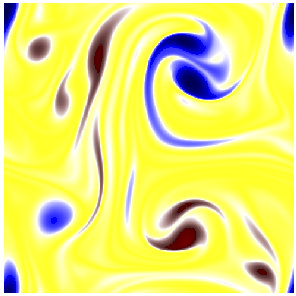
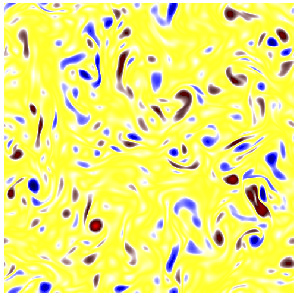
Figure: The vorticity fields after many eddy turn over times are presented, showing intermittency of two-dimensional turbulence at moderate Reynolds number. Left: decaying turbulence, right: forced turbulence. This work aims to develop multiresolution approaches for investigating intermittency of coherent structures in the atmosphere. A multiresolution atmospheric modelling system has been proposed and verified using a coastal circulation system of a dry atmosphere. Further extension to understand an appropriate parameterization for moisture effect and turbulence are in progress. Fully-Lagrangian adevection schemes for industrial, environmental, or geoscience applications

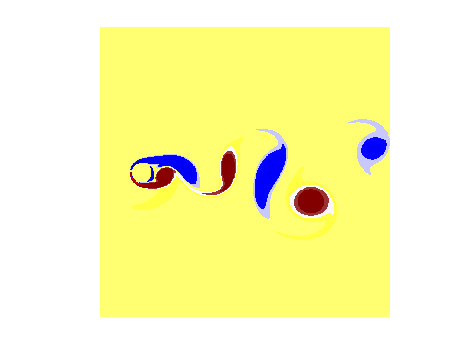
Figure: Numerical simulation of a moving front in a channel. Top: Fully-Lagrangian, bottom: Eulerian. A computer model of the atmosphere or ocean concerns advection dominated flows. The realization that numerical treatment of advection on a conventional Eulerian mesh is plagued with instabilities and unrealistic negative constituent values has inspired continuous efforts in finding more elegant tools for improving state-of-the-art atmospheric transport and chemistry models. A fully-Lagrangian advection scheme has been developed for accurate simulation of advection dominated flow problems. The model has been compared with standard Eulerian finite different approaches. We found that the fully-Lagrangian model provieded significant improvements in terms of both CPU time and accuracy. Two types of problems were considered: a two-dimensional flow, where a fluid is injected into a domain confined in one direction and containing a resident fluid, and a two-dimensional sea-breeze circulation of a dry atmosphere in the coastal region. A computer model for the geological storage of greenhouse gasses, and for oil/gas reservoir simulation are potential application of this method. In addition, I am also interested in extending this work towards a fully-Lagrangian 3D simulation of the atmosphere, and in comparing the result with classical approaches - for example - semi-Lagrangian and flux-form Eulerial schemes. Energy-conserving Computational Fluid Dynamics (CFD) techniques in complex geometryIn aerodynamics, off-shore drilling, or wind engineering of buildings, one needs simulate moderate to high Reynolds number incompressible flows around arbitrary solid structures. For an adaptive mesh simulation of such flows, a potential challenge is to resolve the coupling between the velocity and pressure such that the incompressibility of the flow is satisfied. I study the development of novel energy-conserving algorithms for flow around arbitrary obstacles. In this approach a penalization method is used to model both the pressure gradient force and the force exerted by solid obstacles. I am interested to examine this algorithm for complex geometry flows and to compare the result with that of classical projection algorithms.
Figure: Vortex shedding at the wake behind a cylinder. Left: Adaptive wavelet solution, right: Adapted grid |